By: John Curtin
The Pixfra Arc A613 is a compact thermal imaging unit that has seen increasing use in ecological surveys, particularly for bat activity and emergence monitoring. The following notes summarise field performance across several surveys conducted in 2025, with an emphasis on practical strengths and limitations
Size, Weight, and Power
The A613 is notably small and light compared with some of the larger Guide Track thermals we use, which makes it easier to carry alongside other survey equipment. It comes with two interchangeable batteries, useful for longer survey sessions, and the option to charge via a car charger is practical when moving between remote sites.
In terms of recording behaviour, the A613 continues recording until manually stopped, unlike some Guide Track units that automatically power down after an hour and 40 minutes. The A613 also splits recordings into 30‑minute segments, storing them in folders organised by hour, which makes file management straightforward when reviewing footage later.
Practicality verses infrared camcorder
We also use a Canon XA10 with supplementary IR torches and floodlights. This setup produces exceptionally sharp detail within 10–15 meters, but performance drops off noticeably at greater distances. It is also more prone to practical issues: the camcorder and torches relies on multiple separate batteries, and if any one of them fails the entire recording can be compromised. In addition, the system takes longer to assemble and configure on site.
Tripod Mounting: Slightly Fiddly, but Worth It
The unit can be mounted on a tripod using an L‑bracket. The bracket is slightly fiddly to set up, but once attached it functions adequately. As with most thermal devices, tripod mounting generally improves footage quality, especially for static roost watches or long‑range scanning.
Field of View
The field of vision is good for most ecological applications, offering enough coverage for typical roost entrances and open‑area monitoring. The Guide TK614 still provides a wider field of view, which may be preferable for large façades or complex structures. For buildings with multiple potential emergence points, more than one thermal unit may still be required, regardless of model.
Reviewing Footage and Thermal Palettes
Across multiple tests, white hot proved the most effective palette for reviewing footage. It provides clearer contrast and makes small movements easier to detect. When aimed at a roost entrance, the A613 often shows a brief white spot just before a bat emerges, which can help with tracking. When reviewing footage form any thermal its best on large screen as it can be easy to miss bats.
Detection Range and Real‑World Performance
The A613 performs well at moderate to long distances for its size. At one quarry site, Daubenton’s bats were visible at approximately 80 m, even with background heat from the quarry cliff face. Against the sky, detection distances increase due to stronger contrast. These observations suggest the unit is suitable for a range of survey scenarios, though—as with all thermals—performance varies with environmental conditions.
Connection to Other Devices
You can wifi the A613 to a phone/tablet, but cannot directly add a cable which has less of a time delay. My Cannon XA10 guides can be linked to a screen via a cable. This is a slight negative aspect to it, but not a deal breaker.
Cost and Value in Context
Thermal imaging has become more accessible in recent years. For comparison, the Guide 19 mm cost around €3000 in 2022, whereas the A613 is available at a noticeably lower price. While not directly equivalent in specification, the reduced cost makes the A613 a practical option for ecological survey work, particularly for teams needing multiple units or backup devices.
Summary
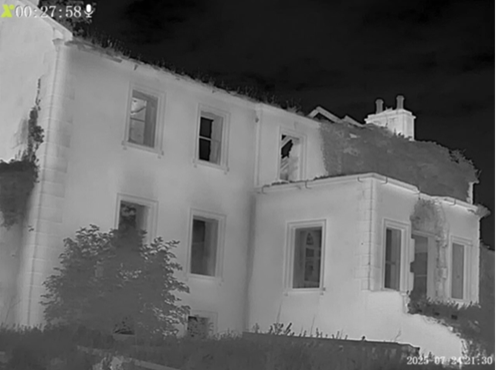
Image taken from Pixfra Arc A613 © John Curtin
The Pixfra Arc A613 offers a combination of portability, adequate field of view, and solid detection performance for ecological surveys. Key points include:
- Lightweight and easy to transport
- Two interchangeable batteries with car‑charging capability
- Tripod mounting improves stability, despite a slightly fiddly bracket
- Good field of view, though narrower than the TK614
- White hot palette provides the clearest review footage
- Effective detection at moderate to long distances in varied environments
- Lower cost than earlier thermal units commonly used in ecology
Overall, the A613 is a practical, functional tool for bat surveys and general nocturnal wildlife monitoring, particularly where budget or portability is a consideration.
John Curtin is an independent Ecological Consultant and a Co-Chair of Bat Conservation Ireland. His review of this product is based on his own use of this product which was purchased through his work as an Ecoogical Consultant.