An all-Ireland charity that promotes the conservation of bats and their habitats

Bat Conservation Ireland

  • Join
  • Donate
  • Shop
  • 0 items€0.00
  • Our Work
        • Monitoring

        • Monitoring and Distribution Projects
        • All Ireland Daubenton’s Bat Waterways Survey
        • Car-based Bat Monitoring
        • Brown Long-eared Bat Roost Monitoring
        • Lesser Horseshoe Bat Roost Monitoring
        • BATLAS 2020
        • Resources

        • Publications
        • Education and Training

        • Learn About Bats website
        • Gardening for Bats
        • Bats and Bugs website
        • Online Training Platform
  • Irish Bats
        • What is a bat?
        • Species
        • Lifecycle
        • Echolocation
        • Distributions
        • Bat Landscapes
        • Bat Hotspots
        • How are Irish bats doing?
  • Advice
        • Common questions answered
        • Found a Bat?
        • Bats and Development
        • FAQs
  • Get Involved
        • Become a Member
        • Donate
        • Volunteer Your Time
        • Request a bat walk, talk or other event
        • Share your bat knowledge
        • Summer Bat Count
        • Bat Sightings
        • Funding for Bat Projects
        • How to Watch Bats
        • Gardening for Bats
        • Creating Roosts – Bat Boxes
        • Bats and Farming
        • Bats and Forestry
        • Bat Detectors – getting and using them
  • Events & Training
  • Bat Groups
  • About
        • Our people
  • Search
You are here: Home / Irish Bats / What is a bat?

What is a bat?

Bats are mammals. This means that they have fur covered bodies, they are warm blooded and give birth to live young. Mothers feed their newborn babies milk. Bats are the only mammals that can undertake true powered flight. A diagram of a bat’s wing is shown below. A bat’s wing is similar to a human hand except the thumb is small and claw-like, while the remaining digits (fingers) are long and there is skin stretched between them. There is a large area of wing membrane between the bat’s fifth finger and its body/leg.
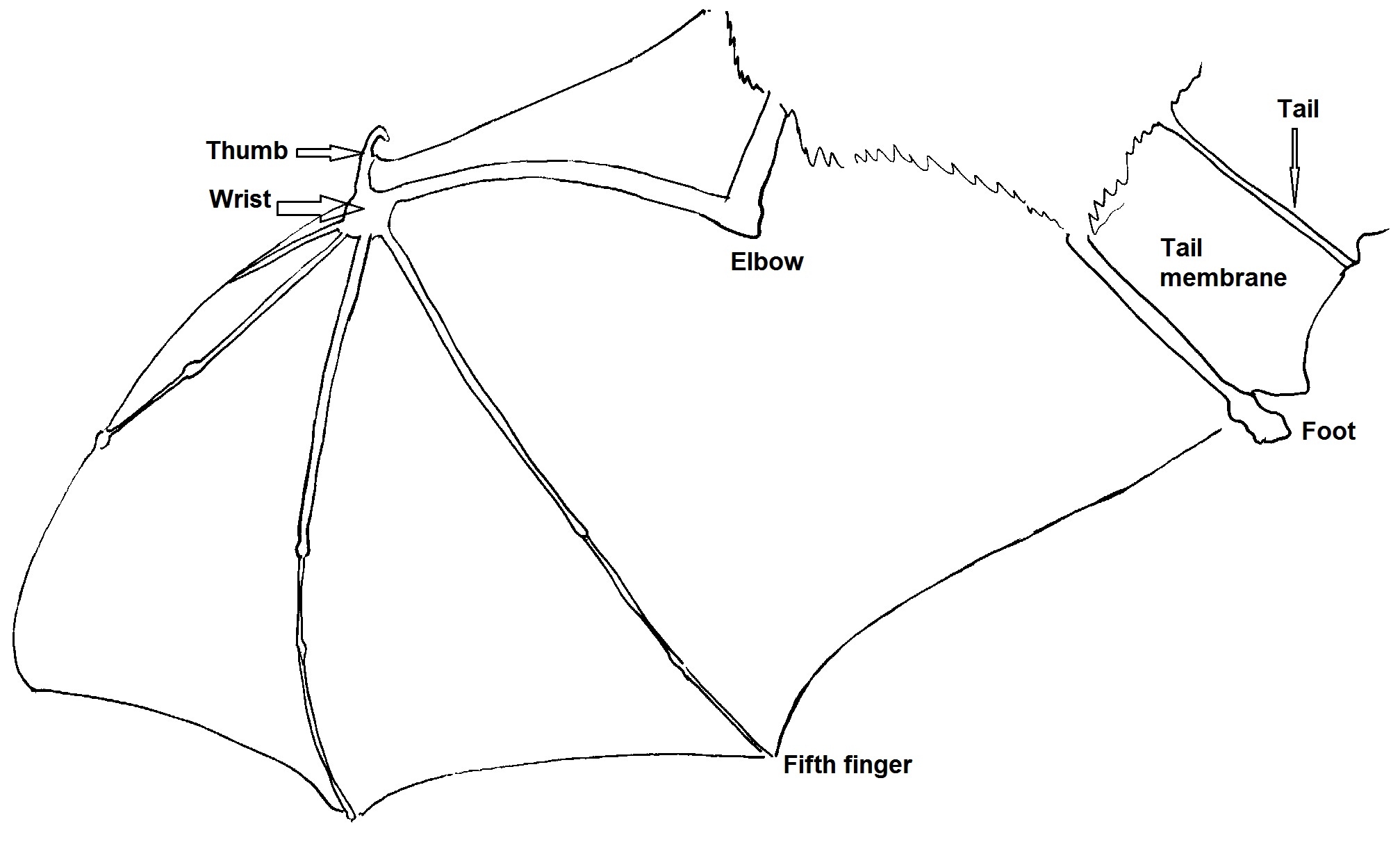
WingStructure

Bats belong to the Order Chiroptera and there have been 1,466 species identified as of May 2024.

Many bat species, including all of the species found in Ireland, use sound to find their way around in the dark and to catch prey to eat. This is known as echolocation. Bats usually use very high pitched sounds beyond the range of human hearing (i.e. ultrasound) to echolocate.

Photo credit: Paul Van Hoof

In the tropics there is a wider variety of bat species. Fruit, insect, vertebrate and even blood consuming bats can be found in some warm tropical countries. Further north or south in cooler climates, bat faunas are usually less diverse and bats in northern Europe, including Ireland, are entirely insectivorous, i.e. they eat only insects.

In Europe, where 45 bat species have been recorded, there is just one species that eats fruit – the Egyptian fruit bat. Although it is found in parts of Africa and the middle east its European distribution is confined mainly to Cyprus and parts of Turkey.

In addition, the rare greater noctule bat found in Mediterranean countries regularly includes small birds in its diet.

  • What is a bat?
  • Species
  • Lifecycle
  • Bat Roosts
  • Protection & The Law
  • How are Irish bats doing?
  • Distributions
  • Bat Landscapes
  • Echolocation

Bat Conservation Ireland,
Carmichael House,
4-7, North Brunswick Street,
Dublin 7
D07 RHA8

We’re on Facebook and Twitter
As well as Instagram and YouTube

  • My Account
  • Terms & Conditions
  • FAQs
  • Privacy & Security Policy
  • Contact Us
  • Sitemap

Bat Conservation Ireland is a company limited by guarantee not having a share capital, registered in Dublin, Ireland.
Company registration number 494343. Charity Registration Number 20039417.

Copyright © 2026 Bat Conservation Ireland | Website built by Made in Trenbania