Have a Natter(er) November 2026
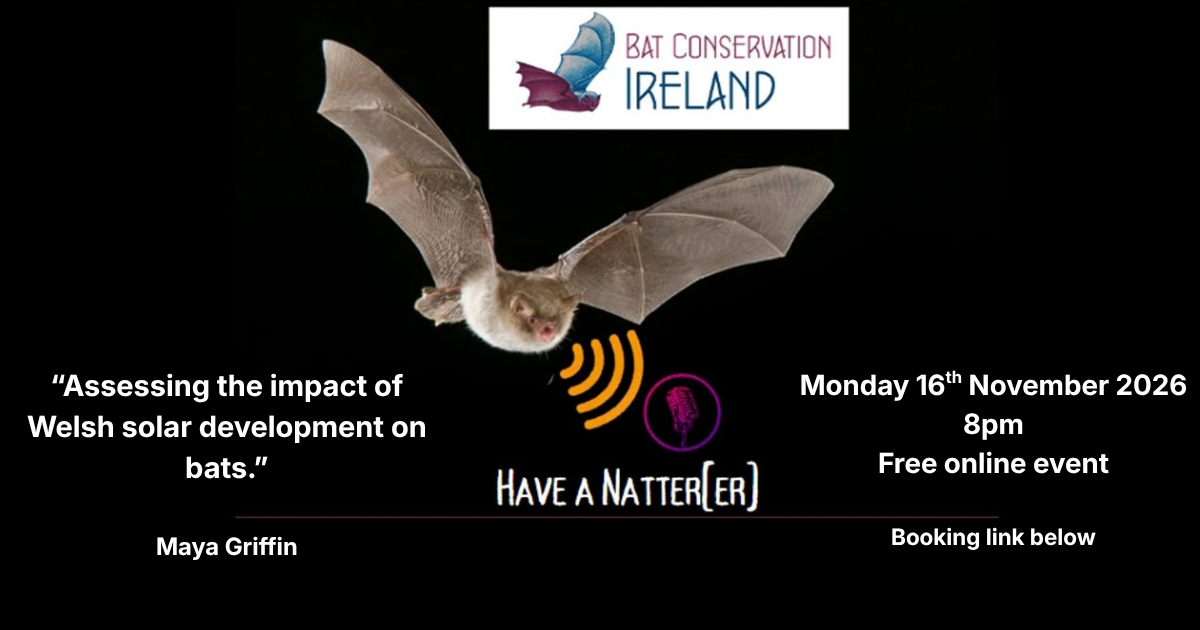
Our ‘Have a Natter(er) Webinar Series returns on Monday 16th November.
We are delighted to be joined by Maya Griffin, a PhD student at the University of the West of England (UWE) and the University of Bath, studying the impacts of solar developments and noise on bats. Her PhD, part-funded by RSK Biocensus, aims to answer questions directly relevant to ecological consultancy. Maya will be presenting a project UWE carried out in collaboration with the Bat Conservation Trust for Natural Resources Wales, assessing the impacts of solar developments on bats in Wales.
Description: Solar photovoltaic development is expanding rapidly across landscapes that also support bats and other wildlife, contributing to a growing “green–green dilemma” between renewable energy deployment and biodiversity conservation. Despite this expansion, the ecological understanding of solar impacts on bats remains limited and largely comes from from short-term studies, leaving planning and mitigation reliant on weak evidence. In this talk, I will discuss our review of the literature, looked at existing knowledge, examined current practice, identified key evidence gaps, and developed recommendations to inform future policy and guidance. Most Welsh utility-scale ground-mounted photovoltaic facilities are located within pastoral landscapes and frequently occur near designated conservation areas, including Special Areas of Conservation, Sites of Special Scientific Interest, Ramsar sites, and Ancient Woodland. These patterns mean there is a lot of potential for interaction with important bat habitats. Current evidence suggests that bat responses to solar developments are highly variable and strongly shaped by many different factors. Developing guidance for survey, assessment, mitigation, and monitoring is essential. Improved baseline datasets, long-term monitoring, and greater data sharing across industry, consultants, and researchers would strengthen the evidence base. Ultimately, landscape-scale planning that considers habitat connectivity and cumulative impacts will be critical to ensuring the transition to renewable energy is compatible with bat conservation.
Read the full report here: Assessing the impact of Welsh solar developments on bats.
Registration required – see link below.
Our webinars will be recorded so that you can view them on our YouTube Channel: BatConservation Ireland – YouTube